
Your best player is staying after practice.
Getting extra shots. Doing the work. Coming in early, leaving late, doing everything a serious player is supposed to do.
And somewhere in the national team pipeline, there is a player doing the same things — with five times the volume. Five times the repetitions. Five times the opportunities for muscle memory to form, for technique to compound, for confidence to become automatic.
Your player is working hard. The other player is building infrastructure.
That gap doesn't close through effort. It closes — or it doesn't — based on what the training environment makes possible.
What the Federation Actually Sees
When the French national team selection process unfolds, the coaches evaluating prospects are not watching talent. They have already filtered for talent. What they are watching is readiness — the specific, physical, automatic readiness that only comes from thousands of deliberate repetitions executed under pressure, with accountability, with feedback, without wasted motion.
The players who arrive ready did not get there because they believed harder. They got there because their training environment could give them what elite preparation actually requires.
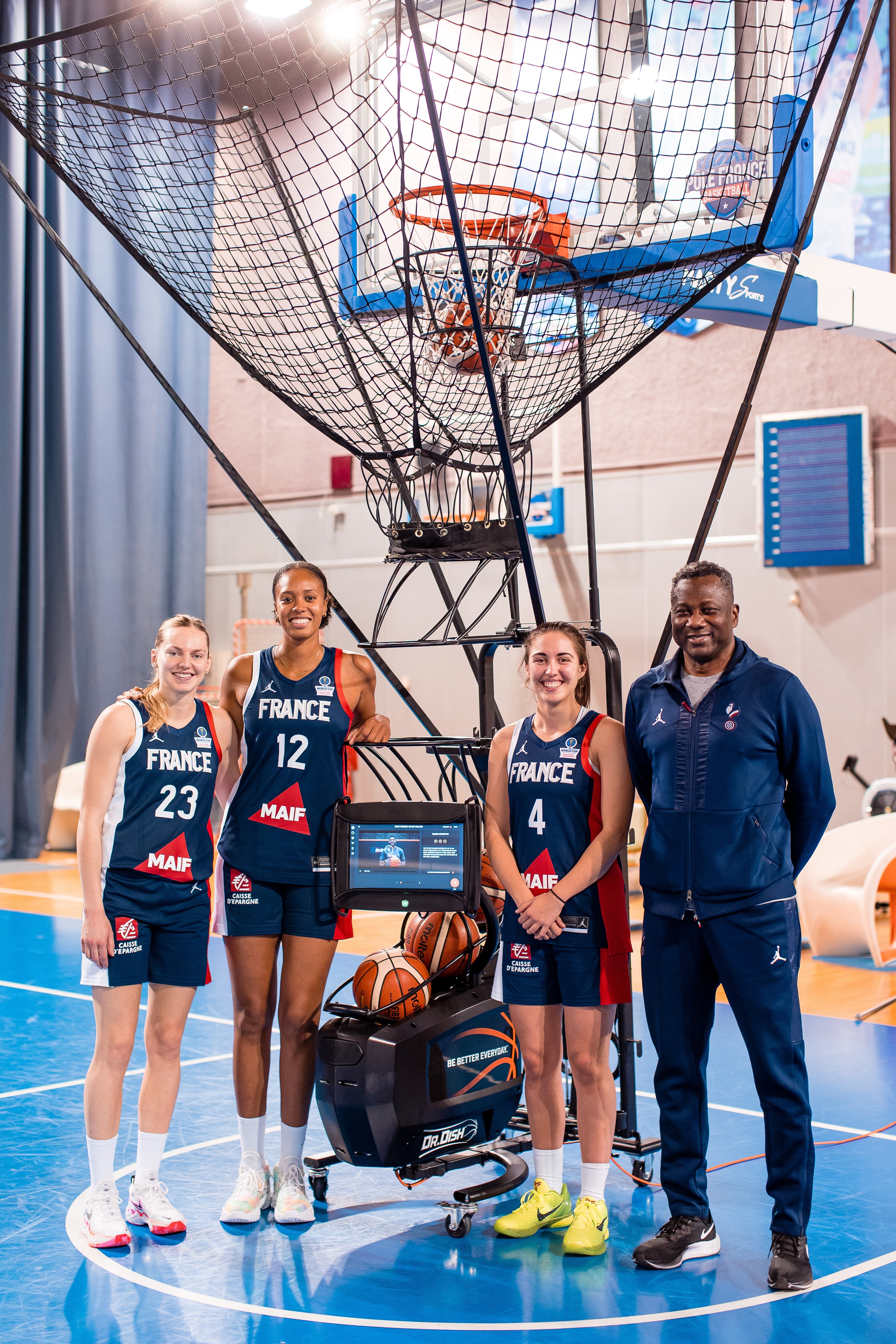
Jean-Aimé Toupane, head coach of the French Women's National Team, has seen both sides of that line. He has worked with players who arrived ready and players who arrived close. The difference, in his experience, was not mentality. It was not even coaching quality.
It was the system behind the preparation.
"This tool has revolutionized basketball," he said — not about a philosophy, not about a methodology. About the infrastructure that made his training environment capable of delivering on the philosophy he already had.
That word matters. Not improved. Not enhanced. Revolutionized.
The Math That Changes Everything
Here is where most clubs stop reading — because the number makes them uncomfortable.
In national team preparation, players leave with 400 repetitions. A player in a typical club session — even a well-run one, with a committed coach, a real system, genuine intent — leaves with somewhere between 60 and 80.
Sixty to eighty versus four hundred.
Multiply that by four sessions a week. Multiply that by a season. You are not running a different version of the same program anymore. You are running a fundamentally different program — one that compounds in the direction of readiness, and one that compounds in the direction of the gap.
That difference doesn't show up immediately. It shows up when one player makes the roster — and the other is still "close."
The player getting 400 reps is not working harder. They are working inside an environment that removes the ceiling on repetition. The player getting 80 is working at the ceiling of what a coach with two hands and a philosophy can physically deliver.
That ceiling is not a motivation problem. It is not a philosophy problem. It is an infrastructure problem — and it costs players something specific, every session, whether the coach sees it or not.
The Conversation Happening Above Your Gym
There is a quiet reckoning taking place at the federation level across Europe.
The programs producing players who arrive at national team selection ready — genuinely ready, not talented-but-behind, not promising-but-raw — are not necessarily the programs with the best coaches. They are the programs that understood early that a coach's philosophy is only as powerful as the environment that can execute it.
The best coach in France, running the best drills in France, rebounding for players herself, cannot give a single player 400 clean shooting repetitions in a 90-minute session. It is not physically possible. The time doesn't exist. The hands don't exist.
Which means the standard the national team expects is not achievable through coaching alone.
FIBA — the international body governing this sport across every European market — does not endorse training systems casually. Their endorsement of Dr. Dish was not a partnership. It was a recognition: this is the system that closes the gap between what coaches intend and what players actually receive. It is the only shooting system to carry that endorsement. And it earned it because it solves the one problem that coaching philosophy, by itself, cannot.
Volume. Accountable, tracked, session-after-session volume — at the scale that national team development actually demands.
.jpg?width=4640&height=6960&name=Alexandre%20Aygalenq%20-%20photo%20by%20Lars%20Vernier%20(2).jpg)
What Changes When the Ceiling Disappears
A coach running a session with Dr. Dish does not choose between coaching and feeding. The machine feeds. The coach coaches. The player gets 400 repetitions instead of 80 — and the coach gets to be present for all of them, watching, correcting, developing.
That is not an efficiency gain. That is a transformation of what the session is.
It is the difference between a coach spending 40 minutes of a 90-minute practice managing logistics — rebounding, resetting, chasing balls, reorganizing lines — and a coach spending 90 minutes doing the only thing that actually develops players: coaching.
The players who will represent France in the next generation are being formed right now. Not in national team camps — those come later. They are being formed in the daily sessions, the weekly accumulation, the compounding of repetitions inside environments that either have the infrastructure to reach the standard or don't.
Talent doesn't fall behind. The environment does — and the player pays for it.
The Only Question Left
The national team standard is not hidden. It is not secret knowledge available only to federation insiders. It is visible, documented, and reachable — for any program willing to build the infrastructure to meet it.
The programs that will look back on this season as the moment things changed are already asking the right question. Not "is this necessary?" — because the math has already answered that. They are asking: How do we build this? How do we close the gap before it becomes permanent?
The programs still asking whether the standard applies to them will have their answer at selection.
The national team standard isn't waiting. The only question is simple:
Are your players training in a system that can reach it — or one that guarantees they won't?
#FeedYourFire
Dr. Dish Basketball is the only shooting training system formally endorsed by FIBA — used by elite programs across Europe, including the French Women's National Team. Connect with your local Dr. Dish partner to learn how to bring the standard to your program.